
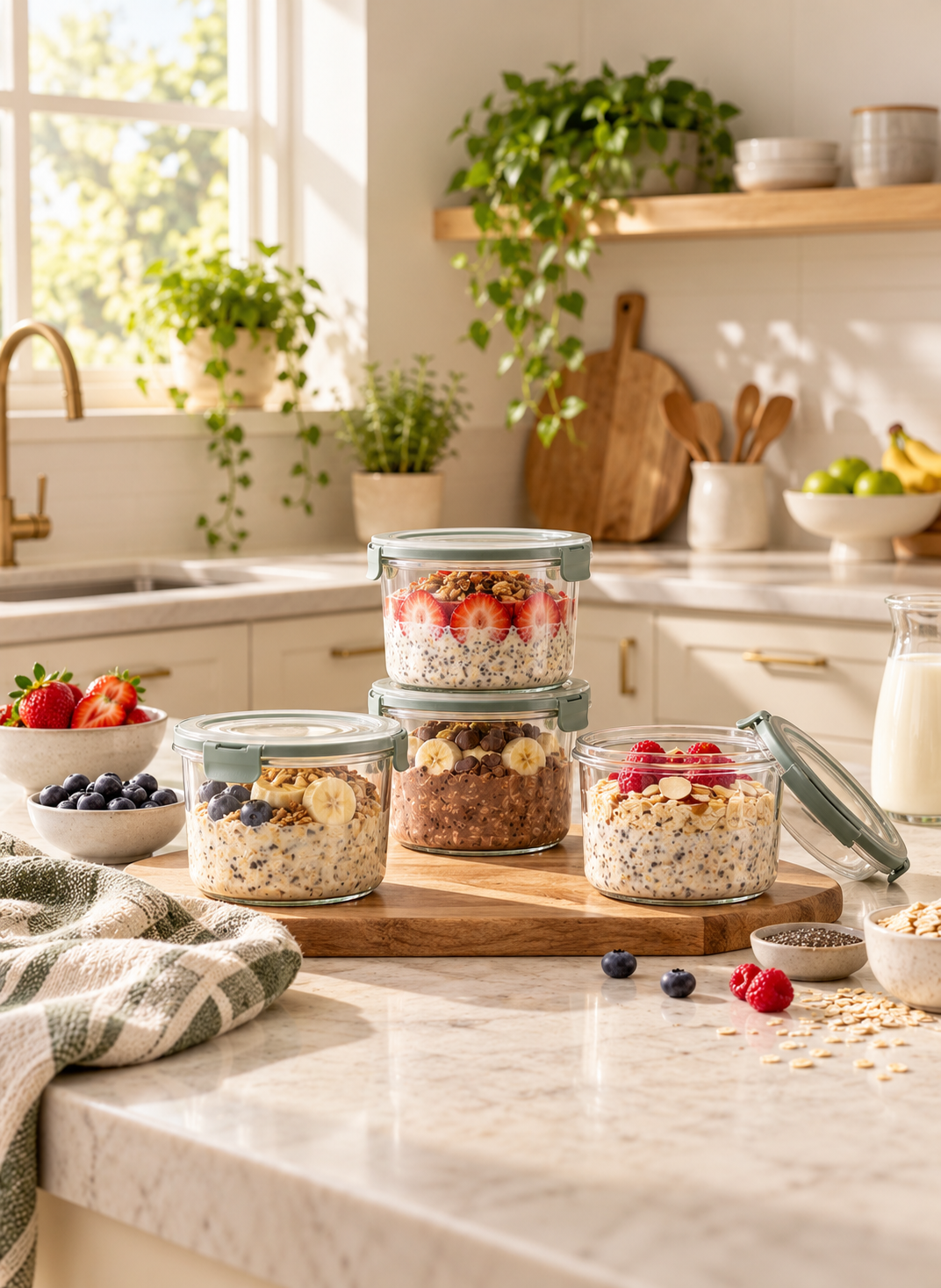
A good overnight oats container needs to do more than hold oats overnight.
If you prepare breakfast before work, university or the school run, the container has to fit in the fridge, travel in a bag without making a mess, hold enough food for breakfast and be easy to wash afterwards.
The best container for overnight oats depends on how you eat them. Someone making a small portion of oats and milk needs less space than someone adding yoghurt, berries, banana, nuts and granola.
For most people, the important things to check are capacity, material, lid design, separate topping storage and portability.
What size container is best for overnight oats?
There is no single ideal size because overnight oats portions vary considerably.
A basic portion might contain:
-
oats
-
milk or a milk alternative
-
yoghurt
-
chia seeds
Once you add fruit, nut butter, protein powder or toppings, the breakfast becomes much larger.
A small jar may be enough if you prefer a light breakfast. If you prepare a fuller meal, you need enough empty space to stir everything without ingredients reaching the lid.
This is why choosing a container based only on the amount of dry oats can be misleading.
The oats absorb liquid overnight and the final breakfast may also include ingredients that were not inside the container during soaking.
Should an overnight oats container have extra space?
Yes.
Filling a container completely to the top makes overnight oats harder to mix.
Leaving some room allows you to:
-
stir the oats properly
-
add fruit in the morning
-
mix in protein powder
-
add extra milk
-
add yoghurt
-
carry toppings without overflowing the container
This becomes particularly useful if you prepare breakfast at home but eat it later at work.
A slightly larger container often gives you more flexibility than a container that only fits the exact portion you prepared the night before.
Is glass or stainless steel better for overnight oats?
Both can work, but they suit different routines.
Glass containers
Glass is popular because you can see the contents and it does not absorb food colours or smells easily.
It works well if the overnight oats stay in the fridge and are eaten at home.
The downside is weight.
A glass jar containing oats, yoghurt and fruit can become surprisingly heavy in a work bag. Glass can also break if dropped.
For someone taking breakfast on a train, bus or daily commute, this can matter more than it would at home.
Stainless steel containers
Stainless steel is lighter and less vulnerable to breaking.
It can therefore be practical for:
-
commuting
-
packed breakfasts
-
work lunches
-
university
-
school
-
travelling
An insulated stainless steel container may also help keep chilled food cooler while you are away from the fridge.
However, stainless steel should not be placed in a microwave. If you regularly heat your oats in the microwave, you need to consider how you normally eat breakfast before choosing your container.
Do overnight oats containers need to be leak-proof?
If the container never leaves your fridge, this matters less.
If it travels in a handbag, backpack or laptop bag, it matters a lot.
Overnight oats often contain milk, yoghurt or other liquids. Even a small leak can create a considerable mess inside a work bag.
Look for a secure screw-top or locking lid with a proper seal.
A container designed for commuting should be able to handle normal movement inside a bag rather than needing to remain perfectly upright at all times.
The Greentainer 26 oz Overnight Oats Container uses a screw-top lid with a silicone seal and is designed for breakfasts that need to travel.
Is a separate topping compartment actually useful?
It depends on what you put on your oats.
Some toppings are fine when mixed in overnight.
Others are much better added shortly before eating.
Granola is the clearest example.
Granola absorbs moisture from yoghurt and oats. Leave it sitting on a wet breakfast for several hours and it normally loses much of its crunch.
The same can happen with:
-
crushed biscuits
-
cereal
-
toasted nuts
-
seeds
-
coconut flakes
A separate topping container allows the wet breakfast to remain in the main section while dry toppings stay separate.
You can combine everything when you are ready to eat.
That means you do not need to carry a second small pot just for granola.
What about fruit?
Fruit depends on the type.
Berries can work well mixed into overnight oats.
Banana can soften and change colour if prepared too early.
Apple pieces may stay firmer if packed separately.
Frozen fruit is often deliberately mixed into the oats because it defrosts overnight and releases juice into the mixture.
There is no rule that every topping needs to stay separate.
A separate compartment simply gives you the choice.
Is 26 oz too large for overnight oats?
Not necessarily.
One important detail is that a dual-compartment 26 oz container does not always mean the whole capacity is one large pot of oats.
For example, the Greentainer Overnight Oats Container has an 18 oz main food container and a separate 8 oz topping section.
That makes the total capacity 26 oz, but the main section is used for the oats, yoghurt, porridge or other meal.
The upper section can hold things such as:
-
granola
-
berries
-
cereal
-
nuts
-
fruit
-
toppings
This setup makes more sense for a full breakfast than thinking of 26 oz as one enormous serving of oats.
Should you choose a container with a spoon?
It sounds like a minor detail until you arrive at work and realise you do not have one.
A reusable spoon that travels with the container is useful if breakfast is regularly eaten away from home.
It also means you do not need disposable cutlery or a separate spoon loose in your bag.
For people who meal prep several breakfasts a week, small conveniences like this can make the routine easier to maintain.
Can the same container be used for yoghurt?
Yes, and this is one reason it can be useful to choose a container based on your wider breakfast routine rather than just overnight oats.
A suitable breakfast pot can also be used for:
-
yoghurt and granola
-
chia pudding
-
porridge
-
cereal
-
fruit
-
yoghurt parfaits
-
snacks
If you do not eat overnight oats every day, a versatile container is usually more practical than one designed around a single recipe.
What about porridge?
Cold overnight oats and hot porridge are different use cases.
An insulated stainless steel container can be useful for porridge when you need to take breakfast with you.
However, always follow the care instructions for the container.
A stainless steel container should never go into a microwave.
If your normal routine is to microwave breakfast at work, glass or microwave-safe food storage may suit that specific habit better.
If you prepare the food before leaving home and simply need to carry it, stainless steel becomes more practical.
Is dishwasher-safe important?
For something used almost every morning, yes.
A breakfast container quickly becomes annoying if it requires complicated hand washing after every use.
Oats and yoghurt can dry around lids and edges, so being able to clean the components thoroughly is important.
The lid should also be easy to take apart or rinse around the seal so food does not remain trapped.
The Greentainer breakfast container is listed as dishwasher safe, which is useful for regular meal prep.
What should commuters look for?
A commuter has slightly different requirements from someone eating breakfast at home.
For work or university, prioritise:
Secure lid
The container may spend an hour moving around inside a bag.
Reasonable weight
You may already be carrying a laptop, charger, water bottle and lunch.
Separate toppings
This is useful if breakfast is prepared at 7 am but eaten at 9 or 10 am.
Built-in cutlery
It removes one more thing to remember.
Enough capacity
A very small pot may be fine for yoghurt but not for a complete breakfast.
Should the container fit in a cup holder?
Not necessarily.
Cup-holder shape is useful for drivers, but many overnight oats containers are wider because a wide opening makes them easier to fill, stir and clean.
Think about where the container actually spends most of its time.
If it goes from your fridge into a backpack and then onto your desk, a wide opening may matter more than fitting inside a car cup holder.
What is the best container for overnight oats in the UK?
For someone eating breakfast at home, a simple glass jar may be perfectly adequate.
For someone carrying breakfast to work or university, the priorities change.
A practical commuter container should ideally offer:
-
enough room for a full breakfast
-
a secure lid
-
durable material
-
separate storage for crunchy toppings
-
easy cleaning
-
a spoon or easy way to carry cutlery
If you regularly prepare yoghurt, granola, porridge or overnight oats for work, a dual-compartment breakfast pot can also replace several different containers.
You can see the Greentainer 26 oz Stainless Steel Overnight Oats Container with Lid and Spoon, which combines an 18 oz main section with a separate 8 oz topping compartment.
The right container is ultimately the one that fits the way you actually eat breakfast. A good jar sitting unused in the cupboard is less useful than a practical container that can move from fridge to work bag every morning.


