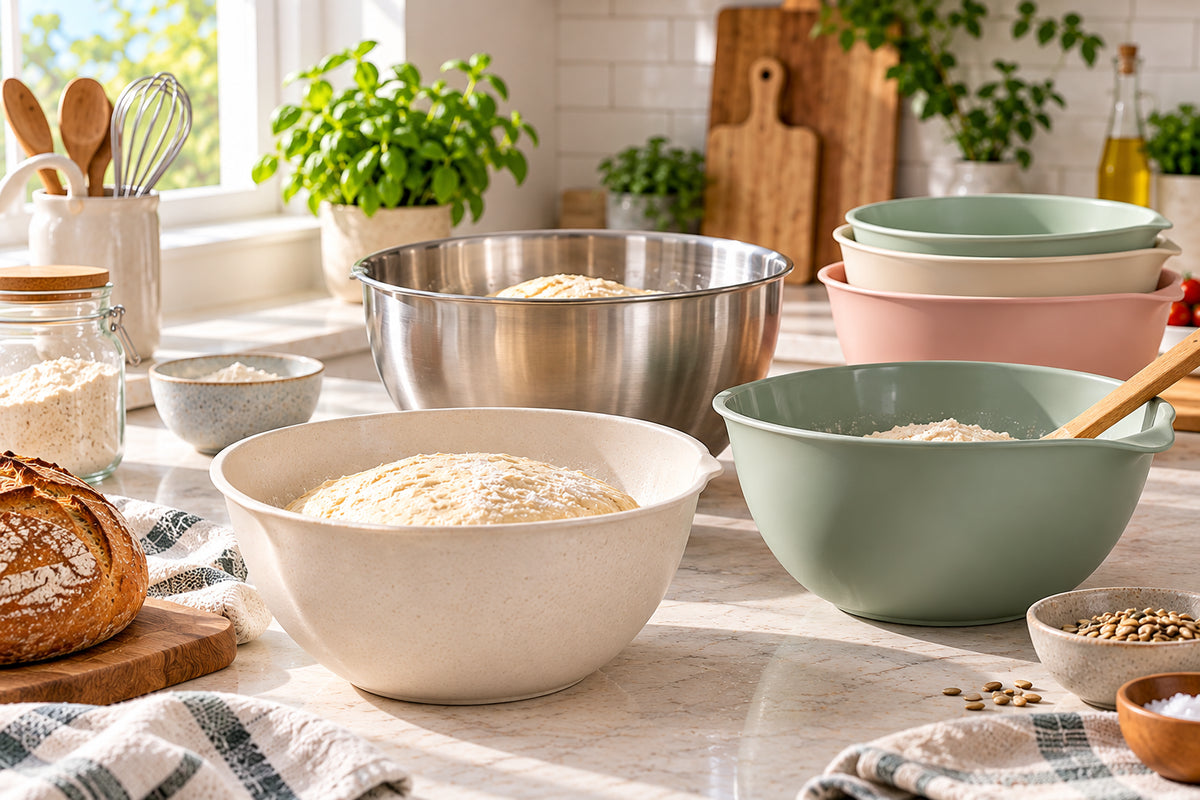
Glass bowls are practical, but not everyone wants to move a heavy bowl around the countertop while baking or cooking.
Especially if you regularly mix cake batter, prepare vegetables, or toss larger salads, the weight of a glass bowl can be bothersome.
That is why many people are looking for lightweight, BPA-free plastic mixing bowls. They should be shatterproof, easy to clean, and as space-saving as possible.
But which plastic bowls are truly suitable? What does BPA-free mean, and is stainless steel perhaps the better alternative?
We compare the materials and show you what to look out for when buying.
Which mixing bowls are lightweight and BPA-free?
If glass is too heavy, plastic and stainless steel are the primary options to consider.
Both materials are suitable for daily kitchen tasks but differ in several respects.
| Feature | BPA-free plastic | Stainless steel | Glass |
|---|---|---|---|
| Weight | Very light | Light | Relatively heavy |
| Shatter resistance | High | Very high | Can break |
| Available with lid | Frequently | Depending on model | Depending on model |
| Space-saving stackable | Frequently | Frequently | Depending on shape |
| Microwave safe | Only if labeled accordingly | No | Depending on product |
| Cleaning | Usually uncomplicated | Uncomplicated | Uncomplicated |
If low weight, matching lids, and multiple bowl sizes are important to you, a BPA-free plastic mixing bowl set is a practical choice.
1. Greentainer 5-piece set: BPA-free mixing bowls with lids
For most households, five different bowl sizes are sufficient.
The Greentainer mixing bowl set with five lids is made of food-grade, BPA-free polypropylene (PP).
The five bowls have capacities of 0.8, 1.3, 2.2, 3.3, and 4.7 liters.
This allows for various tasks: you can whisk salad dressing in the small bowl, prepare cake batter in the medium one, and mix potato salad for the whole family in the large bowl.
The matching lids are particularly practical. You can prepare ingredients, cover them, and store them in the refrigerator afterwards.
All five bowls nest within each other. According to product information, the entire set weighs approximately 980 grams.
The bowls are also labeled as dishwasher, freezer, and microwave safe. Always follow the manufacturer's instructions, especially when using the lids.
Price in the German Greentainer shop: €22.99.
For people looking for lightweight mixing bowls with lids, this set is a practical alternative to heavy glass bowls.
2. Greentainer 6-piece set: More bowl sizes for families
If you regularly cook for several people or prepare various ingredients at the same time, six bowls can be useful.
The Greentainer 6-piece set with stackable mixing bowls offers six bowls with matching lids.
This set is also made of BPA-free polypropylene.
For example, you can chop vegetables, prepare pancake batter, mix salad, and keep ingredients covered until needed.
The stackable design saves space in the kitchen cupboard.
Price in the German Greentainer shop: €29.99.
If you need several mixing bowls anyway, a complete set can be more practical than buying individual bowls from different brands.
3. Are BPA-free plastic mixing bowls truly safe?
This question frequently arises in online discussions.
BPA stands for Bisphenol A, an industrial chemical that was used, among other things, in the production of certain plastics.
A BPA-free mixing bowl is manufactured without this substance.
However, BPA-free does not automatically mean that a product cannot release any other chemical substances.
A scientific study on BPA-free plastic products published in 2014 showed that some tested plastics could release substances that exhibited estrogenic activity in cell tests.
It is important to put this into perspective: the study tested specific plastic products in a laboratory. It does not prove that all BPA-free mixing bowls are harmful to health. Nor can it be directly inferred that there is a concrete health risk for consumers.
Furthermore, the materials investigated are not to be equated with every plastic used today.
The Federal Institute for Risk Assessment (BfR) provides information on Bisphenol A, substitutes, and applicable regulations for food contact materials.
For everyday life, the rule is: use bowls according to their intended use, pay attention to temperature specifications, and replace heavily damaged products.
4. Plastic or stainless steel: What is the better alternative to glass?
In many discussions about lightweight mixing bowls, stainless steel is recommended.
There is a good reason for this.
Stainless steel bowls are also lightweight, very robust, and well-suited for vigorously mixing ingredients.
They are a sensible choice, especially for bread dough, larger salads, or frequent baking.
However, not all stainless steel mixing bowls come with matching lids. Furthermore, they are not microwave-safe.
If you want to use as little plastic as possible during preparation, you can take a look at the Greentainer stainless steel mixing bowl set.
Price in the German shop: €26.99.
The decision therefore depends on your daily kitchen routine.
If you mainly need bowls for mixing and kneading, stainless steel is a good option.
If you prefer using lightweight bowls with matching lids for preparation and storage, plastic can be more practical.
5. What mixing bowl size do you really need?
A large mixing bowl is not necessary for every task.
For a salad dressing or two eggs, a small bowl with a capacity of about one liter is often sufficient.
For cake batter, vegetables, or smaller salads, two to three liters are practical.
Those preparing larger quantities should own a bowl with about four to five liters.
The 4.7-liter bowl from the Greentainer 5-piece set, for example, is suitable for larger salads or mixing ingredients for multiple portions.
A set with different sizes prevents you from having to use the same large bowl for every little thing.
6. What should you look for when buying plastic mixing bowls?
Not every cheap plastic bowl is automatically a good mixing bowl.
Pay particular attention to the following features:
- Material: Food-grade plastic with clear BPA-free labeling.
- Weight: The bowl should be easy to move even when full.
- Lid: Practical for prepared ingredients and storage.
- Sizes: A set of small, medium, and large bowls is more versatile.
- Cleaning: Check whether the bowls are dishwasher safe.
- Space requirements: Nestable bowls require less cupboard space.
If you frequently work with a hand mixer, a stable base and a suitable bowl shape are also important.
Very lightweight bowls can slip during vigorous mixing. A non-slip mat can help.
Frequently asked questions about BPA-free mixing bowls
Can you use BPA-free mixing bowls in the microwave?
Only if they are explicitly labeled as microwave safe. The Greentainer plastic mixing bowls have a corresponding manufacturer indication. At high temperatures, and especially with the lids, the respective instructions for use must be observed.
Are plastic mixing bowls better than glass?
Not fundamentally. Plastic is usually lighter and less prone to breakage. Glass is heavier but has a hard, non-porous surface and, depending on the version, can be suitable for heating food.
Are BPA-free mixing bowls also free of microplastics?
No, this cannot be inferred from the BPA-free label. BPA-free describes the absence of Bisphenol A, not the release of small plastic particles.
Which mixing bowls are suitable for small kitchens?
Nestable mixing bowls with lids are particularly practical because you can store multiple sizes within the footprint of one large bowl.
Conclusion: Which lightweight mixing bowls should you buy?
If glass bowls are too heavy for you, you do not have to forgo versatile kitchen equipment.
BPA-free plastic mixing bowls are lightweight, suitable for everyday use, and often available with matching lids.
The Greentainer 5-piece set is particularly suitable for smaller households and daily food preparation. The 6-piece set offers additional flexibility for families.
If you want to use as little plastic as possible, stainless steel mixing bowls are an equally practical alternative.
At The Greentainer Germany, you will find BPA-free plastic mixing bowls and stainless steel sets for different kitchen needs.
Choose the material and size that you actually need in your daily routine. A good mixing bowl should make your kitchen work easier and not take up unnecessary space.