
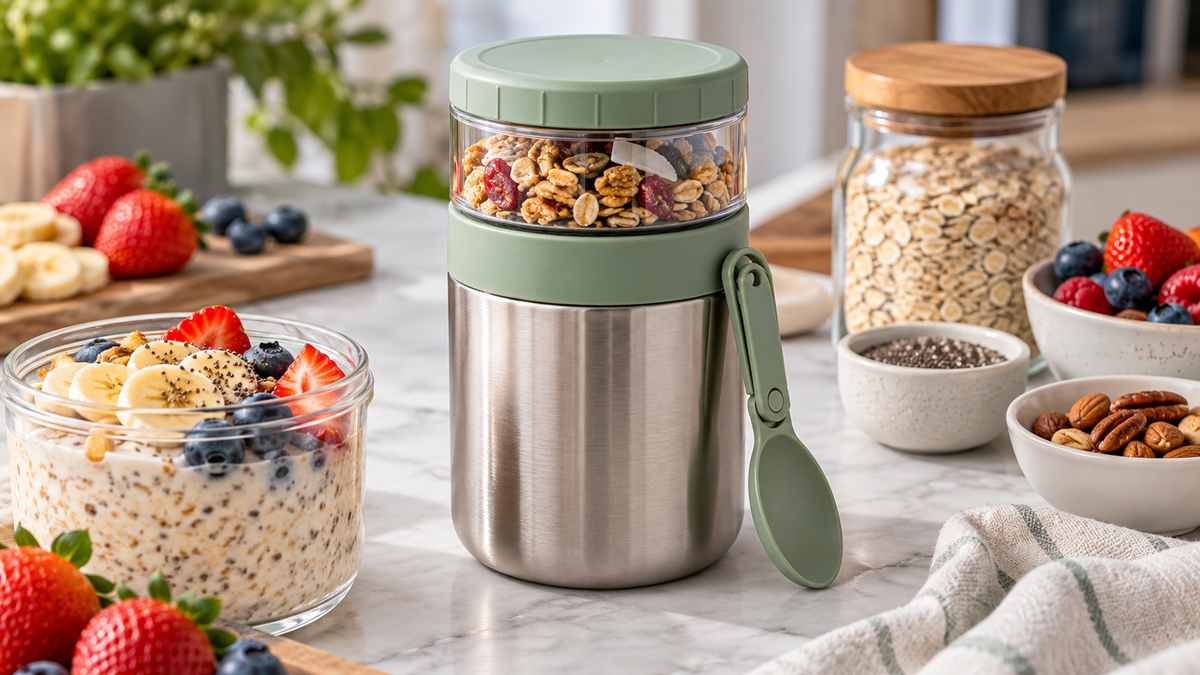
A 26 oz overnight oats container sounds large. After all, many breakfast pots sold in the UK are around 350 ml, 400 ml or 500 ml. So if you only use 40–50 g of oats for breakfast, do you really need a container that holds around 770 ml?
Not necessarily, but the answer changes when that 26 oz capacity is split into two compartments.
A 26 oz overnight oats container can be a very practical size for breakfast when the main section holds your oats or yoghurt and the remaining capacity is used separately for granola, fruit, nuts or other toppings.
That is very different from eating 26 oz of overnight oats in one sitting.
The short answer
A 26 oz overnight oats container is not too big if the capacity is divided between the main breakfast and a separate topping compartment.
For example, the Greentainer 26 oz Overnight Oats Container with Lid & Spoon has:
-
an 18 oz main container
-
a separate 8 oz topping compartment
-
a folding spoon
-
an insulated stainless steel body
-
a screw-top sealed lid
That means your overnight oats, yoghurt or porridge go into the 18 oz lower section, while granola, berries, cereal or nuts stay separate above.
You are not filling a 26 oz jar with oats.
You are carrying a complete breakfast in one container.
How big is 26 oz in UK measurements?
26 US fluid ounces is approximately 770 ml.
But when that capacity is divided, the more useful numbers are:
-
18 oz main container = approximately 530 ml
-
8 oz topping section = approximately 240 ml
For UK shoppers, the 530 ml main section is therefore much closer to a normal medium-to-large breakfast pot than the phrase “26 oz container” initially suggests.
The additional 240 ml is simply separate storage.
Is 530 ml too large for one serving of overnight oats?
For many adults, no.
It provides enough space for a normal breakfast while leaving room to mix the ingredients without filling the container right to the lid.
A UK overnight oats recipe might include:
-
50 g oats
-
around 100–120 ml milk
-
yoghurt
-
berries or fruit
-
nuts or seeds
For example, an NHS Doncaster and Bassetlaw recipe uses 50 g oats, 120 ml milk and 65 g natural yoghurt before adding fruit and nuts.
Once oats absorb the liquid and you add yoghurt, chia seeds, fruit or protein powder, a small breakfast pot can fill surprisingly quickly.
The NHS also publishes overnight oats recipes built around oats, yoghurt and fruit rather than just oats and milk.
A container therefore needs enough space not only to hold the ingredients but also to let you stir them comfortably.
What size overnight oats container is best?
There is no single perfect size.
It depends on how you make your breakfast.
Around 250–350 ml
Best for:
-
light breakfasts
-
smaller portions
-
children
-
basic oats and milk
-
yoghurt without many toppings
The downside is limited room for fruit, yoghurt or stirring.
Around 400–500 ml
Best for:
-
a standard adult portion
-
oats with milk and yoghurt
-
fruit mixed into the oats
-
chia pudding
-
everyday breakfast meal prep
This is one of the most common size ranges appearing across UK overnight oats and yoghurt pots.
Around 500–600 ml
Best for:
-
larger adult breakfasts
-
high-protein overnight oats
-
oats with yoghurt and fruit
-
breakfast after the gym
-
people who like plenty of mixing room
This is roughly where an 18 oz / 530 ml main container sits.
Around 700–800 ml
This can feel unnecessarily large if the whole jar is one single compartment.
However, if the capacity includes a separate topping pot, the comparison changes.
A 530 ml main pot plus a separate 240 ml topping section is far more practical than one 770 ml bowl filled entirely with oats.
Why does container size matter for overnight oats?
People often choose an overnight oats jar based only on the amount of dry oats they use.
That can be misleading.
Oats absorb liquid overnight.
You may also add:
-
yoghurt
-
chia seeds
-
protein powder
-
berries
-
banana
-
nut butter
-
extra milk
-
granola
-
nuts
-
seeds
A container that looks perfectly sized when the oats are dry can become crowded by breakfast time.
You also need some empty space above the food.
That space makes it easier to:
-
stir everything properly
-
add fruit in the morning
-
add more milk
-
mix in toppings
-
eat directly from the container without spilling
So a slightly larger breakfast container often feels easier to use than one filled right to the top.
Why do UK overnight oats jars often come in different sizes?
A look at the current UK market shows overnight oats and yoghurt containers at several capacities.
Common sizes include:
-
300 ml
-
350 ml
-
400 ml
-
430 ml
-
480 ml
-
500 ml
-
600 ml
-
650 ml
-
750 ml
That range tells you something important:
there is no universal overnight oats portion size.
Some people want a compact yoghurt cup.
Others are preparing a complete breakfast with oats, yoghurt, fruit and toppings.
Some UK listings even offer containers around 750 ml, so a larger breakfast jar is not unusual in the market.
The better question is therefore not:
“Is 26 oz too large?”
It is:
“How much of those 26 oz actually holds my oats?”
Is a 26 oz jar too big if I only use 50 g of oats?
If the entire 26 oz is one large compartment, possibly.
If the container uses only about 18 oz for the wet breakfast and keeps the remaining capacity separate for toppings, then it can make considerably more sense.
Consider a breakfast with:
Main container
-
50 g oats
-
milk
-
natural yoghurt
-
chia seeds
-
berries
Topping container
-
granola
-
almonds
-
pumpkin seeds
-
sliced fruit
Now the capacity is being used for two different purposes.
The breakfast itself does not need to fill the entire container.
Why is extra space useful in an overnight oats pot?
A breakfast pot does not need to be full to be correctly sized.
In fact, leaving room is often useful.
Easier stirring
Oats become thicker overnight.
If the container is filled close to the top, stirring yoghurt, fruit or extra milk into the mixture can become messy.
Room for larger recipes
Some days you may make plain overnight oats.
Other days you may add:
-
Greek-style yoghurt
-
protein powder
-
berries
-
banana
-
peanut butter
-
chia seeds
A slightly larger container gives you flexibility.
Less chance of overflow
This is especially useful when carrying breakfast to work.
You do not want yoghurt or oats pushed into the lid every time you mix them.
Is 26 oz too big for yoghurt?
Again, it depends on how the capacity is arranged.
If you want only a small yoghurt snack, then a 26 oz single-compartment container would clearly be larger than necessary.
But a breakfast made from yoghurt plus separate toppings is different.
For example:
Main section
Yoghurt and fruit.
Topping section
Granola, cereal or nuts.
This is why a dual-compartment container can also work as a yoghurt cup, rather than only as an overnight oats jar.
If you like your granola crunchy, keeping it separate is particularly useful.
You can read more in our guide:
Should Granola Be Kept Separate From Yoghurt Until You Eat It?
The simple rule is:
ingredients you want soft can stay with the yoghurt; ingredients you want crunchy are better kept separate.
Is 26 oz too large for breakfast on the commute?
For many commuters, capacity is only one part of the decision.
A breakfast container also needs to be easy to:
-
carry
-
seal
-
open
-
eat from
-
clean
-
fit into a work bag
A smaller jar may save a little space, but you may then need:
-
another container for granola
-
another pot for fruit
-
a separate spoon
A larger dual-compartment breakfast container can combine these into one unit.
That can be particularly useful for:
-
office commuters
-
university students
-
early gym sessions
-
train journeys
-
school runs
-
breakfast eaten at a desk
Should I choose a small overnight oats jar instead?
A smaller jar can absolutely be the right choice.
Choose a 300–350 ml jar if:
-
you eat a small breakfast
-
you use very few toppings
-
you normally eat at home
-
portability is not important
-
you do not need separate topping storage
Choose a 400–550 ml breakfast container if:
-
you eat a normal adult breakfast
-
you add yoghurt or fruit
-
you want space to stir
-
you take breakfast to work
Choose a dual-compartment container if:
-
you want crunchy granola
-
you carry fruit separately
-
you want nuts or cereal away from the wet oats
-
you do not want to carry several small pots
What about a 350 ml overnight oats jar?
A 350 ml jar is one of the most common compact options.
It can work well for:
-
40–50 g oats
-
milk
-
a small amount of yoghurt
-
light toppings
But the container may feel tight if you add several extras.
Imagine:
-
oats
-
milk
-
Greek-style yoghurt
-
chia seeds
-
blueberries
-
banana
-
protein powder
You can quickly lose the empty space needed for mixing.
For a simple breakfast, 350 ml may be enough.
For a fuller breakfast, a larger pot is more forgiving.
Is 500 ml enough for overnight oats?
For many people, yes.
A capacity around 500 ml is a comfortable size for a standard adult breakfast.
It gives you more room than the small 300–350 ml jars without becoming unnecessarily bulky.
That is also why the 18 oz main compartment of the Greentainer container is important.
At approximately 530 ml, the part that actually holds the overnight oats falls within this practical breakfast range.
The additional 8 oz topping compartment should be considered separately.
Why have a separate 8 oz topping compartment?
Because not every ingredient should sit in your oats overnight.
Granola is the obvious example.
If you mix granola into yoghurt or soaked oats the night before, it starts absorbing moisture.
By breakfast, much of its crunch may be gone.
The same applies to:
-
cereal
-
toasted nuts
-
coconut flakes
-
crunchy seeds
-
biscuit pieces
A separate 8 oz compartment gives you enough space to carry these ingredients without needing another container.
You can then add them immediately before eating.
Is 8 oz too large for toppings?
You do not have to fill it.
An 8 oz topping section gives flexibility.
For example, you could pack:
-
granola
-
berries
-
nuts
-
apple
-
cereal
-
seeds
or a combination of several ingredients.
A larger topping compartment also means the food does not have to be packed tightly against the lid.
Think of the capacity as available space, not a serving requirement.
Can a large overnight oats container help with high-protein breakfasts?
Yes.
Higher-protein overnight oats often use more ingredients than a basic recipe.
For example:
-
oats
-
milk
-
Greek yoghurt
-
protein powder
-
chia seeds
-
peanut butter
-
berries
Protein powder and chia seeds can both thicken the mixture considerably.
A small jar may still technically contain the food, but a larger main compartment makes it much easier to stir.
You can then keep crunchy toppings separately.
Can I use the same container for porridge?
Yes.
A breakfast container around 500 ml can also work for:
-
cold porridge
-
yoghurt
-
chia pudding
-
cereal
-
fruit
-
breakfast parfaits
A dual-compartment design can make it even more versatile.
For example:
Main pot: yoghurt
Top: granola
or
Main pot: porridge
Top: berries and nuts
or
Main pot: chia pudding
Top: fruit and cereal
That is useful if you do not eat overnight oats every morning.
Is stainless steel better for a large breakfast container?
Stainless steel is particularly useful for breakfasts that leave the house.
Compared with glass, it does not shatter if dropped.
An insulated stainless steel container can also help maintain food temperature while travelling.
The Greentainer Overnight Oats Container with Lid & Spoon uses a double-wall insulated stainless steel lower container.
One trade-off is worth knowing:
stainless steel cannot go in the microwave.
If you prefer warm porridge, transfer it into a microwave-safe bowl first.
For cold overnight oats and yoghurt, that is generally not an issue.
Is the container too large to carry to work?
The Greentainer container measures approximately 9.9 × 9.9 × 16.3 cm.
Whether that feels large depends on your bag and commute.
If you carry only a small handbag and eat a very light breakfast, a compact yoghurt pot may suit you better.
If you already carry lunch, a water bottle or meal-prep containers, the dual-compartment design may reduce the number of separate items you need.
It also includes a folding spoon, so there is no need to remember cutlery separately.
26 oz versus 350 ml versus 500 ml: which should you choose?
| Size | Best for | Potential drawback |
|---|---|---|
| 300–350 ml | Small breakfast, yoghurt, light oats | Limited room for toppings and stirring |
| 400–500 ml | Standard adult overnight oats | Toppings may still need another pot |
| Around 530 ml | Larger breakfast, protein oats, yoghurt + fruit | Larger than necessary for very light eaters |
| 700–800 ml single container | Very large breakfast or meal prep | Often unnecessary for one serving |
| 26 oz dual compartment | Main breakfast + separate toppings | More capacity than needed if you never use toppings |
The crucial distinction is the last row.
A 26 oz dual-compartment breakfast container should not be compared directly with a 26 oz single-compartment jar.
Who is a 26 oz overnight oats container best for?
It makes the most sense for people who:
-
prepare breakfast the night before
-
eat away from home
-
like granola or crunchy toppings
-
add yoghurt and fruit to oats
-
make high-protein breakfasts
-
prefer one container instead of several small pots
-
want enough room to stir
-
also eat yoghurt, porridge or chia pudding
Who probably does not need one?
A smaller breakfast pot may be better if you:
-
eat only a very small portion
-
never add toppings
-
always eat breakfast at home
-
already use a jar you like
-
want the smallest possible container
-
only need a snack-sized yoghurt cup
There is no benefit in buying more capacity than your routine needs.
So, is a 26 oz overnight oats container too big?
Not when the 26 oz is split between an 18 oz main breakfast container and an 8 oz topping compartment.
The main section is approximately 530 ml, which is a practical size for many adult overnight oats, yoghurt and porridge portions.
The remaining capacity is there for separate toppings.
That means you can pack:
oats below + granola above
rather than carrying a 770 ml serving of overnight oats.
For UK commuters, gym-goers and meal-preppers who regularly add fruit, yoghurt, cereal or nuts, that arrangement can be more useful than squeezing everything into a small jar.
If you are still deciding between materials, capacities and container styles, read our broader guide to the best containers for overnight oats.
If your main problem is soggy cereal or granola, see Should Granola Be Kept Separate From Yoghurt Until You Eat It?.
Or view the Greentainer 26 oz Overnight Oats Container with Lid & Spoon if you want an 18 oz insulated breakfast pot with a separate 8 oz topping compartment.
Frequently Asked Questions
Is 26 oz too much for overnight oats?
A 26 oz single-compartment jar may be larger than most people need for one serving. A 26 oz dual-compartment container is different because the main breakfast section may be much smaller. Greentainer's version uses an 18 oz main pot and a separate 8 oz topping cup.
How many ml is a 26 oz overnight oats container?
26 US fluid ounces is approximately 770 ml.
Is 500 ml enough for overnight oats?
For many adults, yes. Around 400–550 ml usually provides enough room for oats, milk, yoghurt, fruit and stirring.
Is 350 ml enough for overnight oats?
It can be enough for a smaller serving or a simple recipe. It may feel cramped if you add yoghurt, fruit, protein powder or several toppings.
What size jar should I use for 50 g of oats?
A container around 400–500 ml gives 50 g of oats, liquid and toppings more room than a small snack pot. The exact size depends on how much yoghurt, fruit and other ingredients you add.
What is the best size overnight oats container for work?
Around 400–550 ml for the main breakfast is practical for many commuters. A separate topping section is useful if you take granola, nuts or cereal.
Why do I need empty space in an overnight oats jar?
Oats expand as they absorb liquid, and empty space makes it easier to stir in yoghurt, fruit, protein powder or additional milk without spilling.
Is a 26 oz overnight oats jar suitable for yoghurt?
Yes, particularly when it has a separate topping compartment. Yoghurt can stay in the main section while granola, nuts or cereal remain dry until breakfast.
Can I use an overnight oats container for porridge?
Yes. A breakfast pot can also be used for porridge, chia pudding, yoghurt, cereal, fruit and other meal-prep breakfasts.
Is an 8 oz topping compartment too big?
Not necessarily. You do not need to fill it. Extra space lets you carry fruit, granola and nuts together without compressing them.
Should granola be stored separately from overnight oats?
If you want it to remain crunchy, yes. Granola absorbs moisture when left in contact with yoghurt or oats.
Is stainless steel good for overnight oats?
Yes. Stainless steel is durable and does not shatter like glass. An insulated stainless steel container can also help maintain temperature during a commute. It cannot, however, go in the microwave.


