
You bring home strawberries, lettuce, grapes, cucumbers, and a bag of spinach with every intention of using them.
A few days later, the lettuce is wet and limp, the berries are starting to mold, and condensation has collected at the bottom of the container.
So what went wrong?
One of the most common questions about refrigerator organization is whether fresh produce should be stored in an airtight container or a ventilated produce container.
The short answer
Neither airtight nor ventilated storage is automatically better for every fruit and vegetable.
The better choice depends on how much moisture, humidity, and airflow that particular produce needs.
In general:
-
Ventilated or breathable storage works well for produce that is sensitive to trapped moisture.
-
Higher-humidity enclosed storage can help vegetables that wilt easily.
-
Airtight storage is usually better for cut produce than for whole, actively respiring produce.
-
A container with a raised tray or colander can help even when the lid itself is not vented because it keeps produce away from water collecting underneath it.
University of Minnesota Extension notes that unperforated plastic bags can create too much humidity, leading to condensation and mold or bacterial growth, while perforated bags can create the colder, moist conditions many vegetables need.
That is why the real question is not simply:
“Airtight or ventilated?”
It is:
“How much moisture and airflow does this specific fruit or vegetable need?”
Airtight vs ventilated produce containers at a glance
| Storage type | Best suited for | Main advantage | Main drawback |
|---|---|---|---|
| Airtight container | Cut fruit, chopped vegetables, prepared produce | Reduces drying and protects prepared food | Can trap condensation around whole produce |
| Vented produce container | Berries, grapes, some moisture-sensitive produce | Lets excess moisture escape | Too much airflow may dry some vegetables |
| High-humidity produce storage | Lettuce, spinach, carrots, many leafy vegetables | Helps reduce wilting | Condensation becomes a problem if produce stays wet |
| Container with colander/raised insert | Berries, grapes, greens, rinsed produce | Keeps produce above collected water | Does not replace ventilation when airflow is needed |
| Open/breathable pantry storage | Onions, garlic, potatoes and certain produce | Better airflow | Not appropriate for refrigerator produce that needs high humidity |
The key is balance.
Fresh produce contains a lot of water, but water sitting directly on its surface is different from humidity in the surrounding air.
What is an airtight produce container?
An airtight produce container has a lid designed to significantly reduce air exchange with the surrounding refrigerator.
This can be useful because it:
-
reduces moisture loss
-
limits refrigerator odors
-
protects cut foods
-
prevents prepared ingredients from drying out
-
keeps foods organized
But an airtight seal does not automatically make whole fruits and vegetables last longer.
Fresh fruits and vegetables continue biological processes after harvest. They lose water, respire, ripen, and in some cases release ethylene.
If wet produce is sealed into a container and condensation builds up, the trapped moisture may encourage deterioration rather than prevent it.
That distinction is especially important for berries and leafy vegetables.
What is a vented produce container?
A vented produce container, sometimes called a breathable fruit storage container or produce keeper, allows controlled air exchange.
The openings may be:
-
small holes in the lid
-
adjustable vents
-
vents built into the sides
-
perforated inserts
-
airflow channels
The goal is not to dry the produce.
The goal is to let excess moisture escape while retaining enough humidity to prevent excessive water loss.
That difference explains why many dedicated produce-storage systems include both ventilation and a raised tray or colander.
Are vented containers better for fruit?
Often, but not always.
Vented storage can be particularly useful when condensation is the bigger problem than dehydration.
Examples include:
-
strawberries
-
blueberries
-
raspberries
-
grapes
-
cherries
Berries are especially vulnerable because moisture sitting on their surface encourages mold.
The U.S. Environmental Protection Agency specifically recommends washing berries just before eating rather than automatically washing them before refrigerator storage as a mold-prevention measure.
Blueberries also require high relative humidity under ideal commercial storage conditions, demonstrating why “keep berries dry” does not mean they should simply be exposed to unlimited dry refrigerator air. The goal is high surrounding humidity without liquid water remaining on the fruit.
Simple answer
For many berries:
High humidity + no standing water + some airflow = a useful combination.
Are airtight containers good for strawberries?
An airtight container can work for strawberries when moisture is carefully controlled, but sealing wet strawberries inside a container can create the exact conditions you are trying to avoid.
If you use a closed container:
-
remove damaged berries first
-
keep the berries dry
-
avoid letting them sit in collected condensation
-
use a raised insert or colander if possible
-
inspect the container periodically for excess moisture
For more detail on whether specialized produce keepers actually make a measurable difference, read our guide:
Do Produce Storage Containers Actually Keep Fruit Fresh Longer?
That guide looks specifically at moisture control, independent storage tests, berries, greens, and the limitations of freshness containers.
What about lettuce: airtight or ventilated?
Lettuce needs high humidity, but it should not sit in trapped surface moisture.
This is where the airtight-vs-vented debate becomes confusing.
Leafy greens lose water quickly. Give them too much dry airflow and they wilt.
But put wet lettuce into a completely sealed environment with condensation collecting around the leaves and you may end up with slimy greens.
University of Georgia storage guidance places lettuce and many greens among produce that prefers roughly 90–95% relative humidity under ideal conditions.
So the ideal setup is not simply “leave lettuce exposed to air.”
Instead:
retain humidity while keeping liquid water away from the leaves.
A container with an elevated inner basket can help because condensation can settle below the produce rather than directly underneath it.
Why does lettuce turn slimy in an airtight container?
This question appears repeatedly in online food-storage conversations.
The usual problem is not the word “airtight” itself.
It is the combination of:
-
wet leaves
-
trapped condensation
-
damaged leaves
-
warm refrigerator temperatures
-
too little drainage
-
storing the lettuce for too long
In one Reddit discussion, a shopper specifically described lettuce repeatedly becoming slimy in sealed bags and began looking for vented storage instead. Other users discussed produce keepers with small vents and inserts designed to prevent produce from touching pooled moisture.
The community discussion reflects the same basic storage principle found in Extension guidance: excessive trapped humidity can create condensation and encourage spoilage.
Does an airtight container make vegetables last longer?
It depends on the vegetable.
Some vegetables lose quality mainly because they dry out.
Others suffer when moisture becomes trapped.
That is why one refrigerator-storage method cannot be applied to every vegetable.
Consider the differences:
Leafy greens
Need relatively high humidity.
Examples:
-
spinach
-
lettuce
-
kale
-
herbs
Keeping them from drying out matters, but they should not sit in water.
Carrots
Also prefer relatively humid storage because dehydration makes them limp.
Peppers
Require somewhat different conditions and benefit from avoiding excess condensation.
Mushrooms
Generally need more breathable conditions because surface moisture quickly becomes problematic.
Onions and garlic
These are a completely different case.
They prefer lower humidity and good ventilation, rather than being sealed into a humid refrigerator container. University of Georgia notes that high humidity can accelerate decay in onions and garlic.
Which fruits should not be stored in a sealed produce container?
Some produce should not automatically be placed in a refrigerator storage bin at all.
The EPA recommends storing items such as:
-
bananas
-
mangoes
-
papayas
-
pineapples
in a cool location outside the refrigerator.
Potatoes and onions should be kept in a cool, dark location, while basil and winter squash generally stay at room temperature until appropriate to refrigerate after cutting.
So before choosing between an airtight fruit container and a vented fruit storage bin, ask a more basic question:
Does this produce belong in the refrigerator in the first place?
What fruits and vegetables should not be stored together?
Container design matters, but so does what you put inside it.
Many fruits naturally release ethylene, a plant hormone involved in ripening.
The EPA recommends separating produce such as bananas, apples, and tomatoes because the gases they release can speed deterioration of nearby produce.
University of Georgia similarly notes that high-ethylene crops can reduce the storage life or quality of ethylene-sensitive produce.
That means putting five different fruits and vegetables into one large “freshness bin” may defeat part of the purpose of organizing them.
Separate containers can make sense even when you have plenty of room.
What about cut fruit: airtight or ventilated?
This is where the recommendation changes.
Cut fruit should generally be kept refrigerated in a clean, covered container.
Once fruit is sliced, diced, or peeled, your storage priorities change.
You are no longer simply managing how a whole fruit naturally breathes.
Now you also want to:
-
protect exposed surfaces
-
reduce drying
-
prevent cross-contamination
-
prevent refrigerator odors from transferring
-
keep prepared food covered
For meal-prepped fruit, an airtight food-storage container therefore makes considerably more sense than leaving the food exposed to refrigerator airflow.
Do fruit storage containers with colanders work?
A colander or raised basket addresses one of the biggest produce-storage problems:
water collecting underneath the food.
The insert elevates the fruit or vegetables so they do not sit directly in condensation or leftover rinse water.
This can be particularly useful for:
-
grapes
-
strawberries
-
blueberries
-
cherries
-
lettuce
-
spinach
-
fresh herbs
One recurring Reddit question about produce keepers is what the strainer insert actually does. Users commonly describe it as a way of keeping the food separated from water while the container manages humidity and airflow.
That is a different function from a vent.
A vent controls air exchange.
A colander controls contact with collected water.
The two features solve related but different problems.
Is an airtight container with a colander still useful for produce?
Yes, provided you understand what each feature is doing.
An airtight lid reduces uncontrolled air exchange.
The colander separates the produce from excess moisture at the bottom.
For produce where dehydration is a concern, that combination can be useful.
For produce that specifically needs more airflow, however, an airtight container with a colander should not be described as equivalent to an adjustable vented produce keeper.
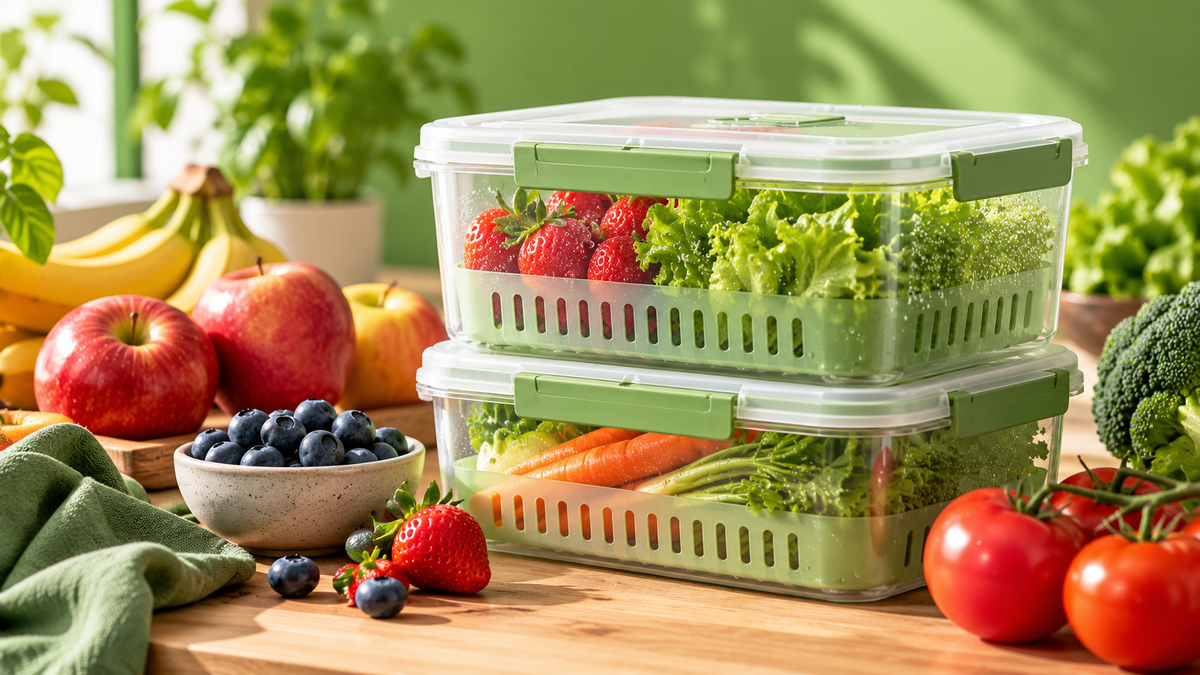
Greentainer's 5L Produce Storage Container with Colander & Airtight Lid uses this approach.
It has:
-
a removable inner colander
-
a 5-liter capacity
-
clear walls
-
a refrigerator-friendly rectangular shape
-
a secure airtight lid
-
a carry handle
The removable basket keeps produce elevated from water collecting underneath while the clear body makes it easier to see what needs to be eaten next.
That last point is underrated.
Produce cannot help you if it disappears behind a carton of milk for ten days.
Airtight vs vented produce container by food type
Here is a practical starting point.
| Produce | Airtight | Ventilated / breathable | Raised colander useful? |
|---|---|---|---|
| Strawberries | Sometimes, if completely dry | Often useful | Yes |
| Blueberries | Sometimes | Often useful | Yes |
| Raspberries | Sometimes | Often useful | Yes |
| Grapes | Can work | Useful | Yes |
| Lettuce | Humidity-retaining storage can help | Controlled airflow can help | Yes |
| Spinach | Humidity-retaining storage can help | Controlled airflow can help | Yes |
| Carrots | Often useful for reducing moisture loss | Less important | Optional |
| Cucumbers | Moderate humidity needed | Some airflow can help | Optional |
| Mushrooms | Usually not the first choice | Prefer more breathable storage | Less important |
| Cut fruit | Yes | Usually no | Not necessary |
| Chopped vegetables | Yes | Usually no | Not necessary |
| Onions | No | Yes | No |
| Garlic | No | Yes | No |
| Potatoes | No refrigerator produce keeper needed | Cool, dark, ventilated storage | No |
This table is a practical household guide rather than a claim that every variety has identical storage requirements.
Temperature, ripeness, damage, refrigerator humidity, and how fresh the produce was when purchased all affect storage life.
Should you wash fruit before putting it in a storage container?
For berries, usually wait until you are ready to eat them.
The EPA recommends washing berries immediately before eating to help prevent mold during storage.
If you prefer to wash produce in advance for meal-prep convenience, it becomes especially important to dry it thoroughly before storage.
That means:
-
rinse
-
drain
-
dry
-
remove damaged pieces
-
store
Do not treat a colander insert as permission to put soaking-wet berries straight into the refrigerator.
It helps manage excess moisture.
It does not make surface water irrelevant.
Why are my berries still molding in a produce keeper?
A produce container cannot reverse deterioration that has already started.
Common reasons include:
The berries were already damaged
Bruised, cracked, or moldy fruit can accelerate spoilage within the batch.
You stored them wet
Water remaining on the berries increases the opportunity for mold growth.
One spoiled berry was left inside
Check the batch before storing it.
The refrigerator is too warm
Temperature has a major effect on produce life.
Condensation is collecting around the fruit
Even a good container needs to be used correctly.
You expected the container to stop natural aging
No container makes fresh food permanent.
That is why our earlier guide on whether produce storage containers actually keep fruit fresh longer emphasizes realistic gains rather than promising a fixed number of extra days.
Are produce keeper containers actually worth buying?
They can be if you regularly lose delicate produce to moisture, crushing, poor fridge organization, or forgetting what you bought.
The value is less compelling if you:
-
buy very little produce
-
eat everything within one or two days
-
already have an effective crisper-drawer system
-
mainly buy produce that does not require refrigerator storage
They become more useful when you regularly buy:
-
berries
-
grapes
-
greens
-
herbs
-
prepped vegetables
-
bulk produce
A dedicated bin also makes refrigerator organization easier because one category of food has a visible home.
For more refrigerator and storage ideas, see our guide to smart kitchen organization.
What Reddit users are really asking about produce containers
Looking beyond product descriptions reveals a useful pattern.
People are rarely asking only:
“Which container should I buy?”
They are asking questions such as:
“Why does my lettuce still turn slimy?”
Usually because moisture control matters more than simply putting lettuce into a sealed box.
“Do the tiny vents actually make a difference?”
They can. Their purpose is controlled air exchange rather than completely exposing the food to refrigerator air.
“Why is there a basket inside a produce keeper?”
To keep produce from sitting in collected moisture.
“Should I wash berries first?”
For storage, keeping berries dry until closer to eating is usually the safer default.
“Do produce saver containers really work?”
Some Reddit users report noticeable improvements, while others say different products made little difference. That mixed experience is important because the outcome also depends on produce quality, moisture, temperature, and storage habits, not only the container.
“Why can't I just use regular food containers?”
You can for many foods.
Dedicated produce containers become useful when they add features regular containers lack, particularly:
-
drainage
-
raised inserts
-
adjustable airflow
-
visibility
-
produce-friendly shape
What home-food communities keep coming back to
Across food-storage communities, the questions tend to become highly specific:
-
How should I store lettuce?
-
What should I do with too many cucumbers?
-
Should berries be washed first?
-
Can carrots and peppers share a container?
-
What produce should stay out of the refrigerator?
-
Can I prep vegetables several days ahead?
-
Why does everything get wet inside my storage bin?
That is a useful lesson when choosing containers.
Do not organize your refrigerator around the container.
Organize it around the food.
Different produce needs different conditions.
So, which is better: airtight or ventilated?
For most households, you do not need to choose one storage method for every fruit and vegetable.
Use each where it makes sense.
Choose more breathable or ventilated storage when:
-
condensation is a recurring problem
-
the produce is prone to surface mold
-
the produce needs airflow
-
you are storing onions, garlic, or other produce that prefers ventilated conditions outside the refrigerator
Choose enclosed, higher-humidity storage when:
-
wilting is the main problem
-
you are storing leafy vegetables
-
you need to limit moisture loss
Choose airtight storage when:
-
fruit has already been cut
-
vegetables have been chopped for meal prep
-
food needs protection from refrigerator odors
-
you want to reduce drying of prepared produce
Look for a raised colander or insert when:
-
condensation collects under your fruit
-
you regularly store berries or grapes
-
you rinse produce in the same container
-
greens tend to sit in collected water
The best produce container manages moisture, not just air
The “airtight versus vented” debate makes produce storage sound simpler than it really is.
Freshness depends on several factors working together:
temperature + humidity + airflow + ethylene + initial freshness + moisture management.
No lid can compensate for fruit that was already moldy when it went into the refrigerator.
No vent can rescue lettuce sitting in a puddle of water.
And no airtight seal should automatically be assumed to be better simply because it sounds more protective.
For many households, a practical middle ground is a container that keeps produce organized while separating it from excess water.
Greentainer's 5L Produce Storage Container with Colander & Airtight Lid is designed around that approach, with a removable basket that lifts fruits and vegetables above moisture collecting at the bottom.
The important part is still choosing the right storage approach for the food inside it.
Frequently Asked Questions
Are airtight containers good for storing fruit?
Airtight containers can work well for cut fruit and for whole fruit when moisture is carefully controlled. For moisture-sensitive whole fruits such as berries, trapped condensation can become a problem, so keeping the fruit dry and elevated from collected water matters.
Should fruit containers have ventilation holes?
Some fruits benefit from controlled ventilation because it allows excess moisture to escape. Berries, grapes, and similar produce are commonly stored in containers that combine airflow with a raised insert.
Is airtight or vented storage better for strawberries?
Vented storage or a system that prevents condensation from remaining around strawberries is often useful. If using an airtight container, make sure the berries are dry and not sitting in accumulated moisture.
Should vegetables be stored in airtight containers?
Some can be, particularly chopped vegetables and vegetables that lose moisture quickly. Others need more airflow. The ideal storage method depends on the vegetable.
Does lettuce need an airtight container?
Lettuce benefits from high humidity but not from liquid water sitting on the leaves. A humidity-retaining container can therefore work, especially when moisture is absorbed or separated from the lettuce.
Why does lettuce get slimy in a sealed container?
Wet leaves and trapped condensation can create conditions that accelerate deterioration. Dry the lettuce well and keep it away from collected water.
Do vented produce containers really work?
They can help manage excess humidity and condensation, particularly for moisture-sensitive produce. Their effectiveness still depends on temperature, food quality, and how the produce is prepared before storage.
What is the purpose of a colander inside a fruit storage container?
The colander raises the fruit or vegetables above water and condensation collecting at the bottom. It can also make rinsing produce more convenient.
Can you put berries in an airtight container?
Yes, but they should be dry and monitored for condensation. Removing damaged berries and keeping the fruit off pooled water are also important.
Should grapes be stored airtight?
Grapes can be stored in an enclosed container, but some airflow and moisture management can help prevent condensation. A raised insert is useful if water tends to collect underneath them.
Should I wash fruit before putting it into an airtight container?
For berries, washing immediately before eating is generally preferable. If you wash fruit in advance, dry it thoroughly before storage.
Are fruit storage bins better than original supermarket packaging?
They may be more useful when they provide drainage, protection from crushing, controlled airflow, or better visibility. Simply moving produce from one sealed plastic package into another does not necessarily improve storage conditions.
What fruit should not go in the refrigerator?
The EPA recommends keeping bananas, mangoes, papayas, and pineapples in a cool place outside the refrigerator. Produce requirements vary by ripeness and type.
Should onions be kept in airtight containers?
No. Onions generally benefit from a cool, dry, ventilated environment rather than sealed, high-humidity storage.
What is the best container for berries?
Look for a system that prevents berries from sitting in excess moisture. A raised tray or colander, clear walls, and appropriate airflow are more important than simply choosing the tightest lid available.


