
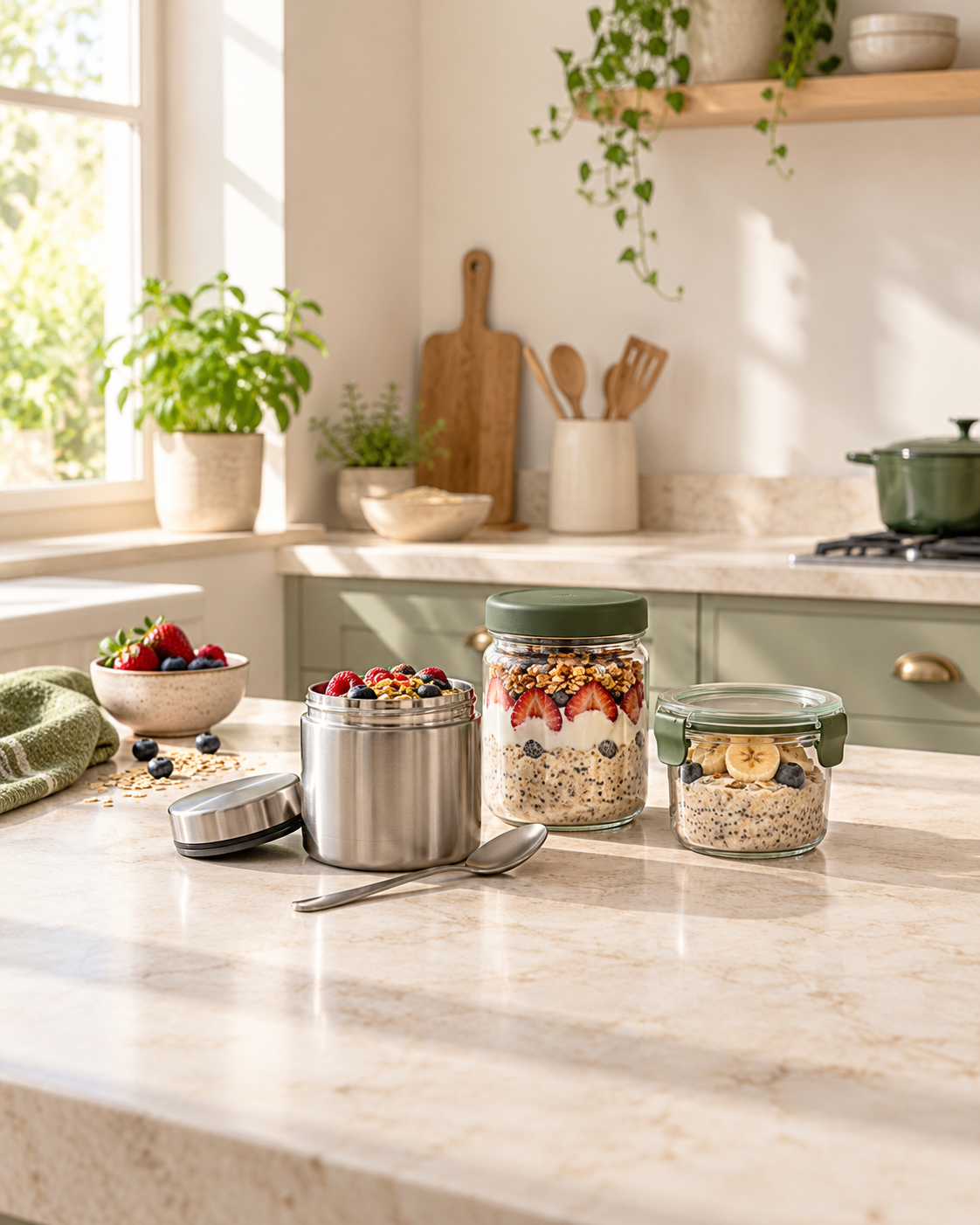
Overnight oats are about the easiest breakfast there is. Stir oats, milk and yoghurt together, pop them in the fridge, and breakfast is waiting in the morning. The container is where it tends to go wrong. Lids leak in your work bag, granola goes soggy, and a pot that's too small leaves no room to stir.
So what's the best container for overnight oats? It depends on whether you eat at home or on the go, but the same few features matter either way.
The short answer
-
For eating at home, any clean pot with a tight lid will do. A glass jar or a plastic tub is fine.
-
For eating on the go, choose a leak-proof pot with a separate topping compartment, so your granola stays crunchy until you eat it.
-
Aim for roughly 400 to 550 ml for one portion, leaving room to stir.
-
If you're buying plastic in the UK, check for a BPA-free label. Great Britain doesn't yet enforce a BPA ban for food containers.
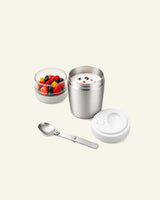
Our stainless steel overnight oats pot has a leak-proof lid and a separate topping compartment, but the guide below will help you choose well whichever pot you end up with.
What makes a good overnight oats pot?
A good overnight oats pot keeps the oats sealed and cold, is big enough to stir, and cleans easily. If you eat breakfast at your desk, it also has to survive a commute. Here's what to look for.
-
A lid that genuinely seals. Look for a silicone seal ring and a screw or twist-lock lid. Snap-on lids can be fine in the fridge but are riskier in a bag.
-
Room to stir. Oats swell as they soak, and you'll want space to mix in yoghurt or fruit in the morning.
-
A wide mouth. It's easier to fill, easier to eat from with a spoon, and much easier to clean than a narrow jar.
-
A separate compartment for toppings. This is the feature that separates a proper breakfast pot from a generic jar. More on this below.
-
Easy cleaning. Dried-on oats are stubborn. Dishwasher-safe parts and a lid without deep grooves save you time.
-
Portability. If you travel with it, check the weight and whether it comes with a spoon.
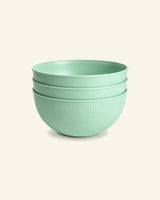
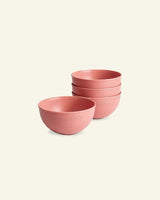
If you mostly eat at home, you don't need anything special. A clean jar with a tight lid works fine, and you can put the money towards a good mixing bowl set for batch prep instead.
Glass, plastic or stainless steel: which yoghurt container is best?
Each material works for overnight oats. The right one depends on where you eat and how rough your mornings are.
|
Glass |
Plastic |
Stainless steel |
|
|---|---|---|---|
|
Best for |
Eating at home, meal prep you want to see |
Budget buys, kids, lightweight packing |
Commuting, gym bags, anyone who drops things |
|
Weight |
Heaviest |
Lightest |
Light to medium |
|
Breakage |
Can crack or shatter |
Won't shatter, can crack over time |
Won't break |
|
Stains and smells |
Resists both |
Can stain and hold smells over time |
Resists both |
|
See what's inside |
Yes |
Usually |
No |
|
Keeps oats cold |
No |
No |
Yes, if double-walled and insulated |
|
Microwave |
Often yes (check the lid) |
Check the label |
No |
A note on BPA for UK shoppers. BPA (bisphenol A) is a chemical used in some hard plastics and coatings. The EU's ban on BPA in food contact materials has a first key compliance deadline of 20 July 2026, and it applies in Northern Ireland, according to GOV.UK. Great Britain is different. The Food Standards Agency consulted on a ban in late 2025 and still intends to bring one in. However, it has said there will be no enforcement until domestic legislation is introduced.
In practice, that means a BPA-free label is still worth checking for on plastic pots and lids sold in England, Scotland and Wales. Glass and stainless steel sidestep the question for the main container, though lids and seals are often plastic or silicone.
What size breakfast pot do you need?
For one adult portion, a pot of roughly 400 to 550 ml is a comfortable size. Here's why.
A typical single serving starts with about 50 g of oats. An NHS Doncaster and Bassetlaw recipe pairs 50 g of oats with 120 ml of milk and 65 g of natural yoghurt, then adds fruit and nuts. NHS Forth Valley's version uses 50 g of oats and 100 ml of milk, topped with yoghurt and berries. Once the oats soak and you add fruit, that fills a small pot quickly, and you still need space to stir.
-
Under 350 ml: fine for a light portion or a child's breakfast, but tight once fruit goes in.
-
400 to 550 ml: the sweet spot for one adult, with room to mix.
-
Over 600 ml: better for batch prep at home, which you then portion out.
If you pack toppings separately, remember the topping space is extra. A small 200 to 250 ml compartment is plenty for granola, nuts or berries.
Why a separate granola pot makes such a difference
If you like crunch, keep your toppings apart until you eat. Granola, nuts and seeds soak up moisture from yoghurt and milk, so a topping added the night before is soft by morning. We cover this in more detail in our guide on whether granola should be kept separate from yoghurt.
There are two ways to do it:
-
A two-part pot. The oats sit in the main container, and a smaller cup for toppings sits inside the lid or on top. Everything travels as one piece, and you tip the toppings in when you're ready.
-
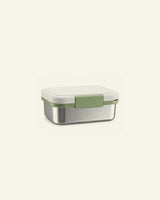
Two separate containers. This works if you want a larger breakfast or more toppings. A lunch box with compartments keeps fruit, granola and nuts apart in one box.
Fresh fruit depends on the type. Grated apple can go in with the oats overnight, as in the NHS Doncaster and Bassetlaw recipe above. That same recipe defrosts frozen berries in the fridge overnight next to the oats and adds them in the morning, which also suits soft fruit like sliced banana.
How long do overnight oats keep in the fridge?
The safest approach is to make overnight oats no more than a day or two ahead, and to keep them in a fridge at 5°C or below.
The Food Standards Agency doesn't publish specific guidance for overnight oats. Its general advice for prepared food is to keep your fridge below 5°C and to eat leftovers within two days. Overnight oats are made with milk and yoghurt, so it makes sense to follow the same two-day rule and never go past the use-by date on the milk or yoghurt you used.
A few habits help:
-
Check your fridge temperature. An inexpensive fridge thermometer tells you whether the dial setting actually gets you to 5°C.
-
Seal the pot. A tight lid stops the oats drying out and picking up smells from other food.
-
Keep them cold on the go. If breakfast sits in a bag for a while, an insulated pot or a cool bag helps keep it chilled until you eat.
So, what's the best container for overnight oats in the UK?
If you eat at home, the best container is the one you already own, provided it has a tight lid and room to stir. If you take breakfast to work, the gym or the school run, a leak-proof pot with a separate topping compartment is worth it.
That's the gap our Overnight Oats Container with Lid & Spoon is built for. It has:
-
a double-walled, vacuum-insulated 304 stainless steel jar of about 530 ml (18 US fl oz), which helps keep oats cold on the way to work
-
a separate BPA-free topping cup of about 240 ml (8 US fl oz) for granola, nuts or fruit
-
a leak-proof lid with a silicone seal
-
a reusable folding spoon
One honest trade-off: like any stainless steel container, it isn't see-through and can't go in the microwave. If you like your oats warmed, decant them into a bowl first.
Packing breakfast for the kids too? Our 4-pack snack containers are sized for fruit, crackers and smaller portions.
Frequently asked questions
Can I use a jam jar for overnight oats?
Yes. Any clean jar with a tight lid works at home. The drawbacks are a narrow mouth that's harder to eat from and clean, glass that can break in a bag, and no separate space for toppings.
Is glass or plastic better for overnight oats?
Glass resists stains and smells and lets you see your layers, but it's heavy and breakable. Plastic is light and cheap but can stain over time. In Great Britain, check that plastic pots are labelled BPA-free, as the FSA isn't yet enforcing a BPA ban.
How big should an overnight oats pot be?
For one adult, about 400 to 550 ml. A typical portion starts with around 50 g of oats plus 100 to 120 ml of milk and some yoghurt, and you need extra space for fruit and stirring.
How do I keep granola crunchy in overnight oats?
Store it separately and add it just before eating. A breakfast pot with a separate topping compartment makes this easy on the go.
How long can I keep overnight oats in the fridge?
The FSA has no specific advice for overnight oats, but it recommends eating leftovers within two days and keeping your fridge below 5°C. Following the same rule, and the use-by date on your milk and yoghurt, is a sensible approach.


